As I write this today, it is the 335th birthday of one of my favorite composers, Johann Sebastian Bach (1685-1750). This fact has caused me to reflect on what it is I like so much about his music, and this got me to thinking about fugues. Bach did not invent the structure known as the fugue, but he certainly was a master of this type of composition. It would probably be safe to say that he took the fugue to a whole new level.
A fugue is described as “a musical composition in which one or two themes are repeated or imitated by successively entering voices and contrapuntally developed in a continuous interweaving of the voice parts” (thanks, Merriam-Webster). What is fascinating with fugues is the way in which these voices call out and talk back to each other. Each voice could be played independently, and would be judged to be a fairly complex piece in and of themselves. So, it is astounding when they are all played together that they interweave harmonically – constantly complementing one another, but allowing one voice to stand out at times while the others fade to the background only to have another voice step forward to be heard. Throughout the fugue, several different voices can be heard at one time. At times it may be just one, but it can be two, three or even four voices which are woven together.
To suggest anything like a fugue could emanate from some baboon randomly pounding on a piano would be grossly naïve at best. The composition of a fugue can only be explained by the existence of an intelligent creator, but not just any intelligence. To make this complex composition work out as it does is nothing short of sheer genius.
While Bach probably did not have this in mind when he composed fugues, this type of complexity is also reflected in nature. Take for example, a “simple” photosynthetic cell. In order for this cell to function, several tasks must be accomplished, one of which is the acquisition of energy. Energy is the thing required in order for a cell to be able to “do” anything, but energy is very elusive, and must be captured first.
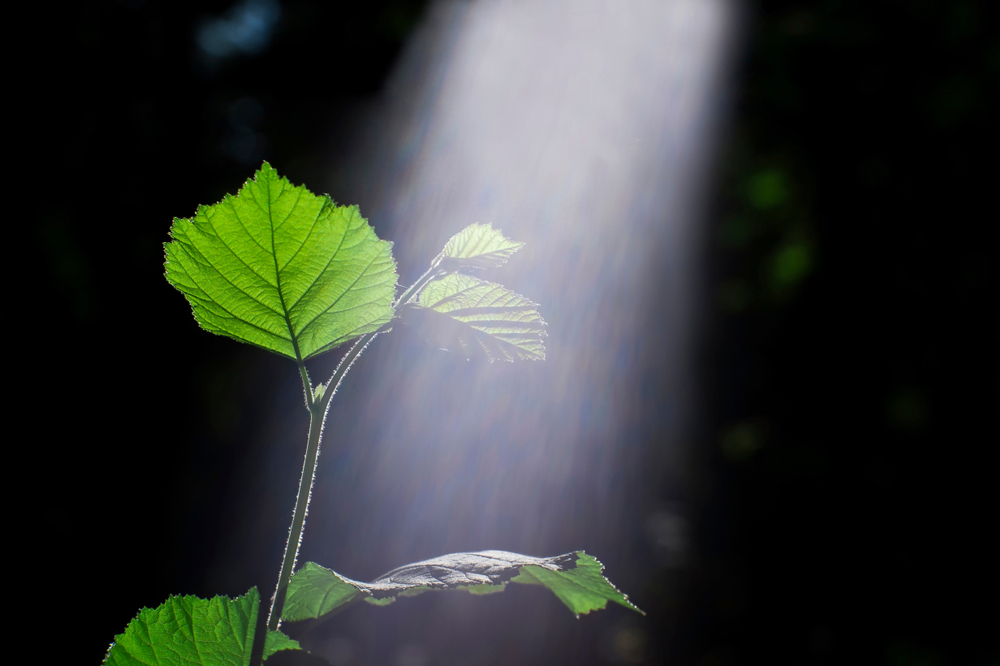
The process of photosynthesis does so by using light energy to break apart a water molecule transferring the light energy into electrons. The energy carried by the electrons drives the biochemical pathways to produce sugars whereby the sun’s energy is stored in its chemical bonds. If all a cell could do was photosynthesis, however, it could not “do” anything because the energy residing in the sugars is not readily available.
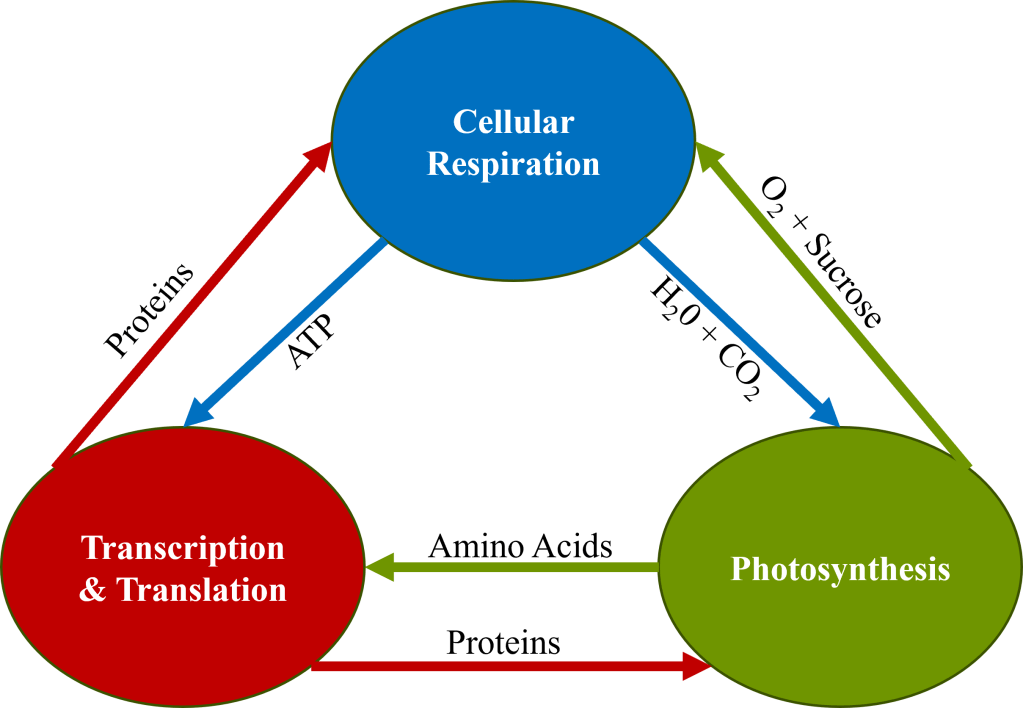
To make use of the energy stored in sugars requires another process known as cellular respiration. In this process, the sugars produced by photosynthesis are systematically broken down by a series of biochemical pathways to create a molecule known as adenosine tri-phosphate (ATP) which becomes the energy carrier within cells. While not the only way cells gather energy, ATP is utilized by a high percentage of biochemical reactions.
The provision of sugar is not the only interplay between photosynthesis and cellular respiration. Cellular respiration also needs the oxygen produced by photosynthesis to break down the sugar molecules. Oxygen is used to take up the hydrogen atoms produced when sugar is decomposed resulting in molecules of water. The water and carbon dioxide which result from cellular respiration can then be used by photosynthesis to construct sugar molecules. The shuttling of oxygen, carbon dioxide and water between these two processes can be regarded as a bit superficial since these molecules can also be obtained from the environment. So, for instance, there is not a direct dependency by photosynthesis on the carbon dioxide released by cellular respiration. This does not mean they are not interdependent. Rather, they are deeply dependent.
Neither photosynthesis nor cellular respiration could operate without a large assemblage of proteins. Some proteins are used as pumps to move ions across membranes. Some are used as catalysts to speed up chemical reactions. Some are built into little nano-machines used to manufacture essential molecules. What becomes interesting is that the processes used to make these proteins (i.e. transcription and translation) require a source of amino acids which are derived from the sugars produced during photosynthesis. Amino acids are manufactured in chloroplasts – the same place where photosynthesis occurs. Protein synthesis also relies upon an energy source to do its work: the ATP which comes from cellular respiration.
While each of these biological processes (voices) is complex in their own right, they cannot function independently. They are inextricably linked. Each process relies upon the other two processes to accomplish its function. The product(s) of each process only find their purpose in their use within the other processes. Photosynthesis is dependent on cellular respiration to produce the ATP needed for making the proteins needed to do photosynthesis. The process of cellular respiration would be worthless unless its products found a use like the production of proteins which makes cellular respiration possible.
What is the origin of such complex interactions? The functioning of these biological processes certainly act in accord with natural laws, just like the voices of a fugue function according to the rules of music theory. But it was not the rules of music theory which produced the fugue. Likewise, natural laws on their own are incapable of interweaving complex biochemical processes. Similar to a fugue, the existence of these integrated biological systems can only reasonably be explained by an intelligent creator who had the insight and forethought needed to weave them together.
J. S. Bach signed the manuscripts of all his church music, and even some of his secular pieces with the initials “S.D.G” which stood for Sole Deo Gloria (to the glory of God alone). While such initials are not stamped inside a cell, it might well be said that the complex inner workings of a cell are indeed singing out like the voices of a fugue. It is as the psalmist writes, “All the earth worships you and sings praises to you; they sing praises to your name.” (Psalm 66:4)
 Cicada Song
Wow! “Wow” is all I can say about the complexity and beauty of fugues and photosynthesis / cellular respiration. Enjoyable to read.
LikeLike