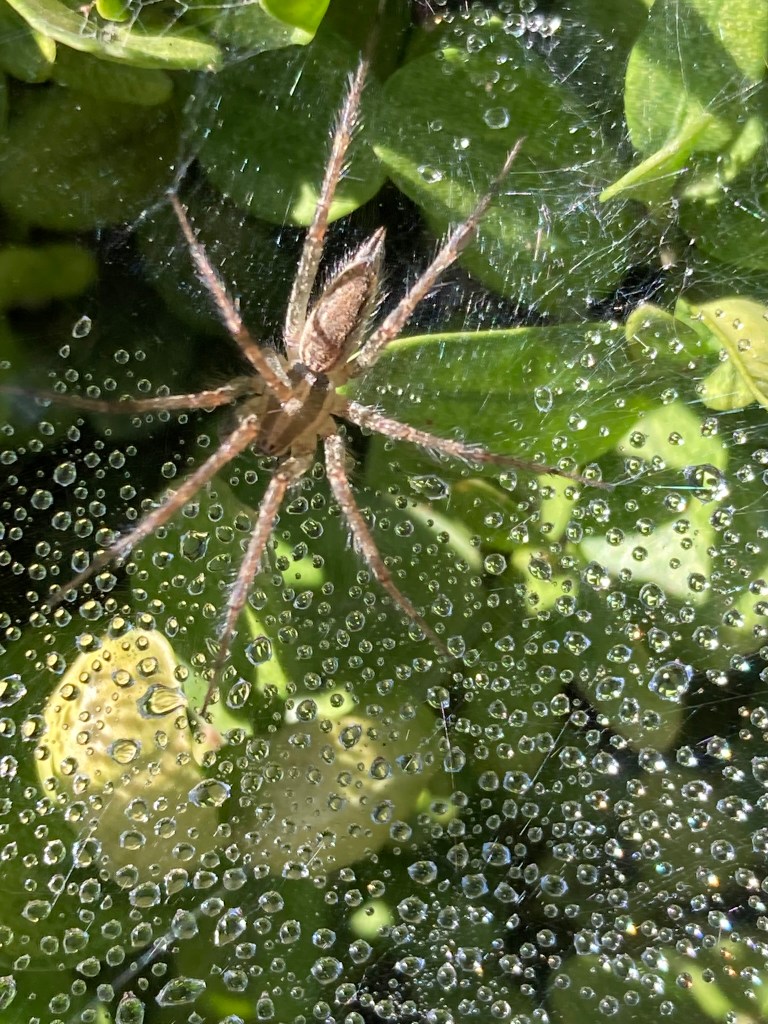
Many years ago, I was visiting missionaries down on the Serengeti plains of Kenya and had a number of wildlife encounters. One which has always stuck with me was meeting up with a golden orb-weaver spider. The name of this spider derives its name from the color of its web. Most spider web is colorless, but this spider includes a pigment in with its web protein which makes it glisten like gold in the sunlight. It is thought this color helps attract insects into the web. In addition to its unique color, the web is also notable because of its size. The web can be a couple feet across and is quite strong. The web is capable of capturing large insects and even small birds and bats for prey. I was able to press my open hand into the web without breaking it

I think of this spider web whenever I read a particular passage in the book of Job. One of Job’s interlocutors by the name of Bildad makes an apt comparison with spider webs. In the midst of his erroneous discourse on how Job’s troubles must be due to some immoral conduct, he rightly describes the condition of those who do not trust in God:
“Such is the destiny of all who forget God;
so perishes the hope of the godless.
What they trust in is fragile;
what they rely on is a spider’s web.
They lean on the web, but it gives way;
they cling to it, but it does not hold”[1]
The resiliency of the golden orb-weaver’s web was impressive, but had I leaned hard enough into it, it would have given way. Most spider webs are not this strong, and break with ease. As we seek things in life which offer us comfort and support, some things are stronger than others, but given enough challenge they will ultimately fail and let us down. Jesus also warned us about putting our trust in the things of the world when he said, “Do not lay up for yourselves treasures on earth, where moth and rust destroy and where thieves break in and steal” (Matthew 6:19)
Rather, Bildad urges Job to pay attention to the wisdom of those who have gone before, who trusted in something much stronger, who relied upon God. Urging his readers toward a greater hope, the prophet Jeremiah wrote, “Yet this I call to mind and therefore I have hope: Because of the Lord’s great love we are not consumed, for his compassions never fail.” (Lamentations 3:21-22)
Job is one of the oldest books in the Bible, and its admonitions are echoed throughout the history of Israel – admonitions which often went unheeded. Much later in their history, the prophets complained about a nation which had absorbed the values of their surrounding cultures and put their trust in ethereal things. The prophet Isaiah decries the injustices of the people of Judah comparing their lies and deceptions to the web of spiders: “They rely on empty arguments, they utter lies; they conceive trouble and give birth to evil…they spin a spider’s web…Their cobwebs are useless for clothing; they cannot cover themselves with what they make.”[2]
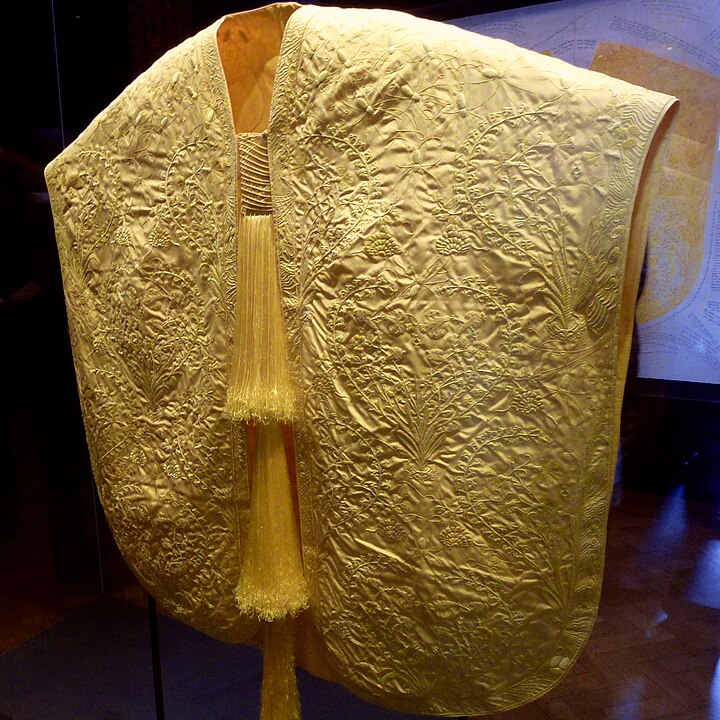
Some people have taken up the challenge, and made efforts to use spider web for clothing. Textile expert, Simon Peers, and entrepreneur, Nicholas Godley, teamed up to produce garments from the silk produced by the golden orb-weaver spider. In order to do so, they had to hire dozens of spider handlers who would bring in spiders collected from the wild. They would carefully handle the spiders to extract their silk and then return them to the wild. In a four-year period, over a million spiders were employed to produce enough silk for the garments they produced[3]. Interesting, but not very practical.
Others have recognized the incredible tensile strength of spider web – stronger than steel – and have looked at the possibility of using it to produce body armor which is tougher than Kevlar. Trying to get enough spider web from individual spiders in order to outfit an armed forces unit would be highly impractical. Instead, they are looking at ways of using genetic engineering to get other organisms to produce this silk protein in large enough quantities for this purpose. It is still in development.
To be sure, Isaiah did not have such things in mind when he wrote down his warnings to Judah. I am sure he imagined people trying to cover themselves simply by pulling down cobwebs from their rafters. Not only do they lack adequate strength for any good purpose, they also are virtually transparent. While they believe their lies and deceptions will conceal the truth, it cannot be hidden for long. This seems to be a common habit for us humans. Much later the apostle Paul would write how God’s wrath will come to those who “suppress the truth”, and “exchange the truth about God for a lie”[4]. Later still, a line in a poem by Sir Walter Scott’s warns, “Oh what a tangled web we weave/ When first we practice to deceive”.
Instead of getting caught up in the insecure webs of deceit, Jesus urges us to be purveyors of truth. He said of himself, “I am the way, and the truth, and the life”, and let us know that, “If you abide in my word, you are truly my disciples, and you will know the truth, and the truth will set you free.” How much better it is to be free from the entanglements of lies. How much better it is to be free from the striving after material wealth and instead follow after Jesus who came that we might have something even better, that we might “have life and have it abundantly”[5].
I do like spiders and find them to be marvels of engineering. Even more marvelous is how the One who designed them could use them to tell us something about the importance of following Him.

[1] Job 8:14-15
[2] Isaiah 59:4-6
[3] Hadley Leggett, “1 Million Spiders Make Golden Silk for Rare Cloth”, Wired (9/23,2009), https://www.wired.com/2009/09/spider-silk/, accessed 12/2/23.
[4] Romans 1:18-24
[5] See John 14:6, 8:31-32 and 10:10, respectively
- By Cmglee – Own work, CC BY-SA 3.0, https://commons.wikimedia.org/w/index.php?curid=19898805 ↩︎
 Cicada Song