“Some people say, ‘nothing can just come out of thin air’, but you do.” This comment was met with a bunch of quizzical looks from my college students. I made this statement in the context of discussing the importance of carbon dioxide in the atmosphere – that it is the source of carbon for ecosystems. The process of photosynthesis uses both carbon dioxide and water to capture solar energy in the form of simple sugars. These simple sugars become the building blocks for other biologically important molecules manufactured by plants: starches, proteins and lipids. Proteins also require nitrogen in their molecular structure which is also ultimately sourced from the atmosphere. These molecules are then passed on to other living things like us, and make up the majority of our body mass. Since sugars only use the hydrogen (a very low mass element) from the water molecule, most of our mass is coming from carbon dioxide and nitrogen – from thin air.
The reason for the quizzical looks was voiced by one of the students who asked, “but doesn’t the Bible say that man is made from the dust of the earth”? He was recalling several passages from the Old Testament[1] like Genesis 2:7 which says, “then the Lord God formed the man of dust from the ground and breathed into his nostrils the breath of life, and the man became a living creature.” The student went on to ask, “does that mean the Bible is wrong”? After all, the Bible is supposed to be inerrant, right?
Soil does contain a mixture of numerous minerals (e.g. calcium, phosphorus, potassium, sulfur) which are necessary for the form and function of our bodies. The amount of each of these minerals in the soil depends on the parent material of the soil, but they are never found in large quantities. For example, most soils would contain less than 50 mg/kg of phosphorus and less than 500 mg/kg of calcium. Soil also contains organic matter from dead plants and animals, but it usually only makes up 1-5% of the soil by mass. So, technically, all the elemental components which make up our bodies could be found in the soil, but the dirt under our feet is largely comprised of a variety of aluminum silicate minerals which are found only in miniscule quantities in our bodies. Given the great dissimilarity between the chemical profiles of soil and our bodies, it seems like a stretch to say that our bodies are literally made from the dust.
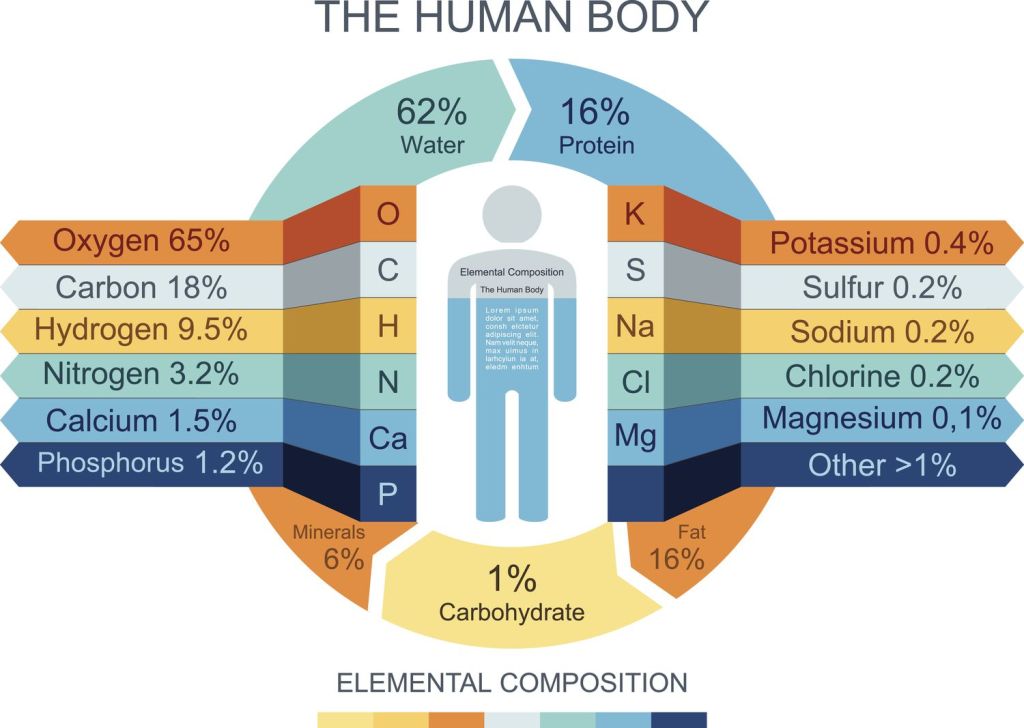
Conceptually, one aspect of our being “dust” which has scientific merit is when God informs Adam and Eve that, “you are dust, and to dust you shall return” (Genesis 3:19). This is echoed by Qoheleth who wrote, “All go to one place. All are from the dust, and to dust all return.” (Ecclesiastes 3:20)[2]. If nature has its way, when our bodies die, they are broken down through the help of a number of different organisms. Most of our mass will be converted through the process of cellular respiration back into carbon dioxide and water. Nitrogen from our proteins can be recycled through the soil or find its way back into the atmosphere. The remaining minerals will find themselves mixed back in with the soil. So, it is accurate to say that the stuff which makes up our bodies will go back to where it came from[3].
That still does not explain why the Bible would say we are made of dust. Both the authors and the original receivers of these texts were not biochemists, and had no understanding about the molecular composition of our bodies. It is fair to say there was no intent to provide any scientific understanding about human biology. Rather, by stating that we are made from dust, I think the authors had something more important to say about mankind than our chemical makeup. In most cases in scripture, “dust” is used metaphorically, and that is likely the case here.
Dust is frequently used as an indicator of lowliness. Out of a sense of humility when speaking to God, Abraham says, “I have undertaken to speak to the Lord, I who am but dust and ashes” (Genesis 18:27). Job laments, “God has cast me into the mire, and I have become like dust and ashes” (Job 30:19)[4]. When it is said that God exalts somebody from their low estate, they are said to be brought up out of the dust[5].

As a particular kind of lowliness, dust is often associated in scripture with defeat. Peoples who are defeated are said to “lick the dust” or “eat the dust”[6]. Recounting his military victories, David wrote, “I beat them fine as the dust of the earth; I crushed them and stamped them down like the mire of the streets” (2 Samuel 22:43). The prophet Isaiah frequently foretells what God will do to opposing nations, that “He gives up nations before him, so that he tramples kings underfoot; he makes them like dust with his sword” (Isaiah 41:2)[7]. More than just a matter of humility, defeat can also bring about the disappearance of a nation – blown away like dust in the wind, they are forgotten.
When Jesus told the disciples to “shake the dust off their feet”[8] if they had not been received well in a village, he was not telling them to literally do a foot washing at the city limits. This action, if they actually did it, was to be a testimony against the people in the city. He was telling them they ought not carry that experience with them – that the rejection of Christ by others should not negatively impact their faith or the gospel message. The “dust” was the worthless rejection of the gospel. The faith of the disciples was to be based on the objective truth of Jesus and his ministry, not on the opinion of others.
Given this common view in scripture of dust being very common, worthless and evanescent, the claim that man is made of dust can be understood in some different ways. The first is that we humans, who are prone to pride and self-conceit, need to practice humility. As the apostle Paul writes, “For by the grace given to me I say to everyone among you not to think of himself more highly than he ought to think, but to think with sober judgment, each according to the measure of faith that God has assigned” (Romans 12:3).

As “dusty” creatures, we are all subject to human frailty and failure, but we can take comfort in the fact that this is precisely the kind of raw material God likes to work with. You will not find among any of the heroes of the Christian faith anyone who accomplished great things because of their own abilities. Paul tells us that in Christ, “’My grace is sufficient for you, for my power is made perfect in weakness.’ Therefore, I will boast all the more gladly of my weaknesses, so that the power of Christ may rest upon me. For the sake of Christ, then, I am content with weaknesses, insults, hardships, persecutions, and calamities. For when I am weak, then I am strong” (2 Corinthians 12:9-10).
Even as “dust”, we are aware that humans are in someway exceptional, but I think we need to recognize our human exceptionalism is not founded on our physical substance. While our human bodies are marvels of engineering, and have some qualities which make us distinct from all other living creatures, it is not made from anything different than the rest of creation. Like everything else in creation, it will decay and vanish from sight. What makes humans truly exceptional is that aspect of us which transcends physical realities – our substance which is of a spiritual nature – the soul which has the capacity to have a relationship with our creator.
This dual nature of man is first conveyed in the creation narrative when God not only forms man “of the dust from the ground” but also had to breath “into his nostrils the breath of life” in order for man to become a living creature (Genesis 2:7). Qoheleth also recognizes a distinction between the physical body the human soul when he wrote, “and the dust returns to the earth as it was, and the spirit returns to God who gave it” (Ecclesiastes 12:7). This is affirmed by the apostle Paul when he declares, “Just as we have borne the image of the man of dust [Adam], we shall also bear the image of the man of heaven [Jesus]” (1 Corinthians 15:47-49).

While the bodies we have now are of a temporary nature, it ought not be said we are just souls with bodies. There does seem to be something fundamental about having a body for our identity as humans. Scripture informs us that we do not just discard our bodies when we die. Instead, we trade them in for something new. Paul states that in heaven Christ “will transform our lowly body to be like his glorious body” (Philippians 3:21). He also describes it as getting a new home: “For we know that if the tent that is our earthly home is destroyed, we have a building from God, a house not made with hands, eternal in the heavens. For in this tent we groan, longing to put on our heavenly dwelling, (2 Corinthians 5:1-2)[9].
So, to my students, no, the Bible is not wrong – it gets it just right. We are first of all made by God, but made from common, lowly stuff. God is able to take the lowest things and do great things with them. Best of all, our “dustiness” is not our eternal estate – God has something better in store for us! Saying we are made from dust is more about who we are (or whose we are) than it is about what we are.
[1] See also, Job 4:19, 10:9, Psalm 103:14,
[2] The wisdom literature and prophets in the Old Testament frequently use the idea of returning to the dust in reference to death: Job17:16, 20:11, 21:26, 34:15, 40:13, Psalm 7:5, 22:15, 29, 30:9, 44:25, 90:3, 104:29, Daniel 12:2, Amos 2:7, Micah 1:10.
[3] Recognizing our inevitable return to “dust”, the process of mourning recorded in scripture sometimes includes putting dust or ashes on the head or sitting in dust or ashes. Some cultures today continue this practice. See Joshua 7:6, Job 2:12, 16:15, 42:6, Lamentations 2:10,21, Ezekiel 27:30, Revelation 18:19
[4] See also Psalm 102:14, 119:25, Isaiah 2:10, Nahum 1:3
[5] See 1 Samuel 2:8, 1 Kings 16:2, Psalm 113:7, Isaiah 52:2
[6] See Psalm 89:39, Isaiah 49:23, 65:25, Lamentations 3:29, Micah 7:17
[7] See also, 2 Kings 13:7, Psalm 83:13, Isaiah 5:24, 17:13, 25:12, 26:5,19, 29:4-5, 47:1
[8] Matthew 10:13-15, Mark 6:10-11, Luke 9:4-5, 10:10-12, Acts 13:50-52
[9] See also Luke 24:36-43, Romans 8:22-23, 1 Corinthians 15:42-53, 2 Corinthians 4:7-14, 5:1-4, 1 John 3:2
 Cicada Song