In a recent post, I indicated there are four gospel stories in which fish play a role. Each story involves a miracle with fish which Jesus used to teach his disciples. Previously, I discussed the stories about two miraculous catches of fish – one at the beginning, and one at the end of Jesus’ time with his disciples (Miracle Fish Part 1). Here, I will explore the other two stories – one which is common to all the gospels, and the other which is found in only one gospel. Both stories provide insights into the salvation which comes through Jesus.
The common story is that of the feeding of the five thousand. The gospels of Matthew and Mark follow this story up with a feeding of four thousand. In both cases, crowds of people have come out to the wilderness to be blessed by the teaching and healing ministry of Jesus. The disciples are faced with the impossible task of providing food for everyone. Jesus asks them what they have available, and they come forward with five loaves and a couple fishes – one gospel tells us this food came from a little boy. Jesus blesses this miniscule amount of food and gives it over to the disciples to distribute. As they do so, the food multiplies as they divide it, and everyone gets fed.
Lest anyone suggest that everyone was fed simply because the people were inspired by the little boy to share their food, Jesus had the disciples pick up the leftover fish and bread. Twelve baskets were collected after feeding the five thousand, and seven baskets were collected after feeding the four thousand. Jesus often had large crowds gather around him, but he did not always feed them. Something different is going on here, and it is not about teaching the disciples how to feed crowds of people. There are a number of things which can be said about the feeding of the multitudes, but here I want to focus on the fish.
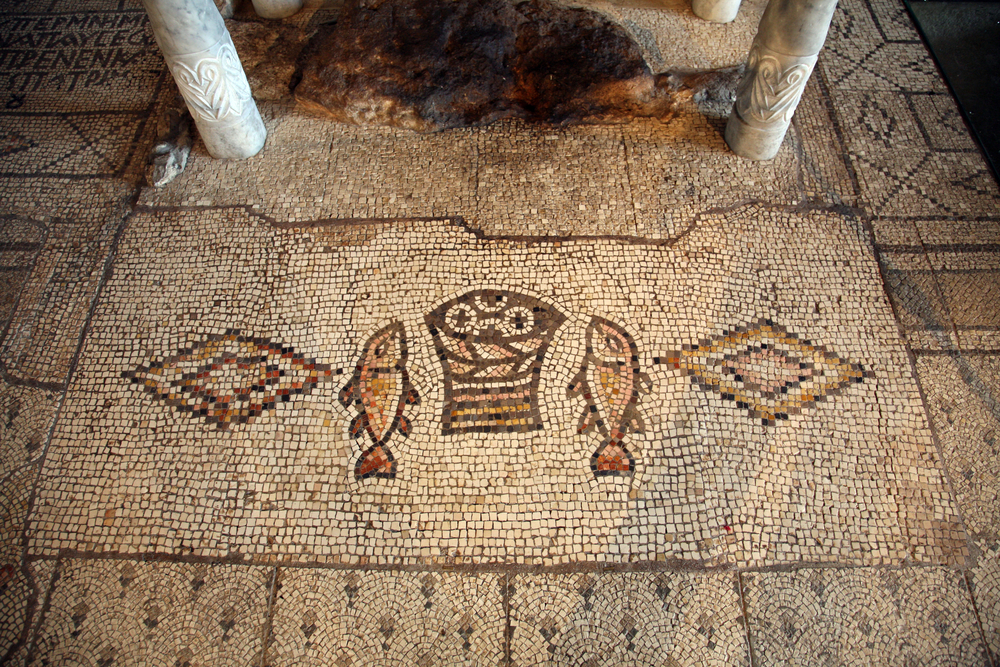
It is helpful to realize that fish was a common part of everyone’s diet in that region. In Jerusalem, one of the gates is referred to as the fish gate which was the place where people would go to buy and sell fish. Jesus also mentions the eating of fish (and bread) in his teaching about how fathers give good gifts (particularly, the Heavenly Father). He said, “Or which one of you, if his son asks him for bread, will give him a stone? Or if he asks for a fish, will give him a serpent?”[1] Meat was eaten by the wealthy, or reserved for special occasions, but fish was the staple protein for the common man.
It is also important to realize the kind of fish which was shared among the multitudes. No fancy sashimi or swordfish steaks were being distributed here. After being out in the wilderness for days, fresh fish would have long since become rancid. Rather, the fish they had would have been preserved using salt. A number of villages along the shores of Galilee had sites specially built for this process[2]. Fresh fish would be stacked (guts and all) in vats with alternating layers of salt and fish. Here the fish would ferment for about a month. The liquid which collected at the top of the vats as the fish and salt compressed was skimmed off and sold as well (fish sauce). After this process, the fish could last for over a year.
The feeding of the multitudes was more than just about getting people fed. It was a sign which points to the gospel. The freely given distribution of preserved fish foreshadows the freely given saving work of Christ’s death on the cross. This gift is not just for the elite – it is for the common man. The collection of leftovers certified that the fish and bread could have only come from Christ. Likewise, the provision of salvation comes through Christ alone and not by any human effort.
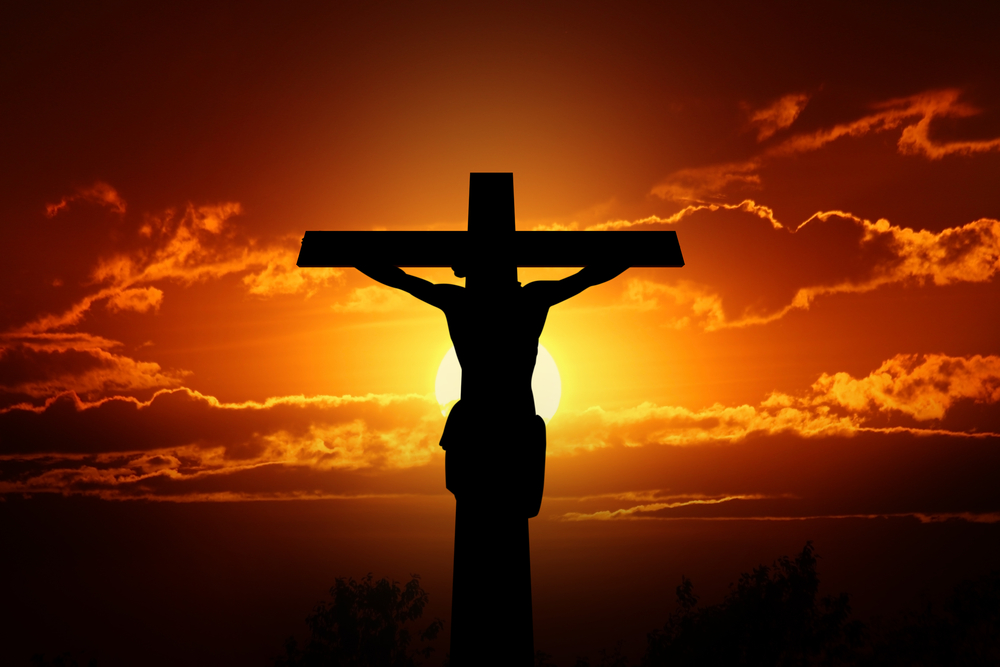
The collection of leftovers is also an indicator that what was distributed was enough for all – nobody should have gone hungry. Some have suggested there is significance in the number of baskets collected: the twelve indicating sufficiency for Israel (i.e., the twelve tribes), and the seven indicating sufficiency for the gentiles. While there was plenty of food to go around, the only ones who benefited from it were those who took part in it. There were many more people in the region than the those who gathered on the shores of Galilee, but the only ones who were fed were those who came to Christ. Salvation in Christ is sufficient for all, but efficient only for those who receive it.
The lessons from this miracle are corroborated by a fish miracle recorded only by Matthew[3]. It is a seemingly odd miracle in which Jesus tells Simon Peter to go catch a fish using a hook (not a net). Jesus tells Peter that the first fish he catches will have a coin in its mouth which he can use to go pay the temple tax. That one would even find a coin in the mouth of a fish is outlandish, but that it would be found in the mouth of a particular fish is even more remarkable. The significance of this miracle can only be understood in the context of the conversation which preceded the miracle.
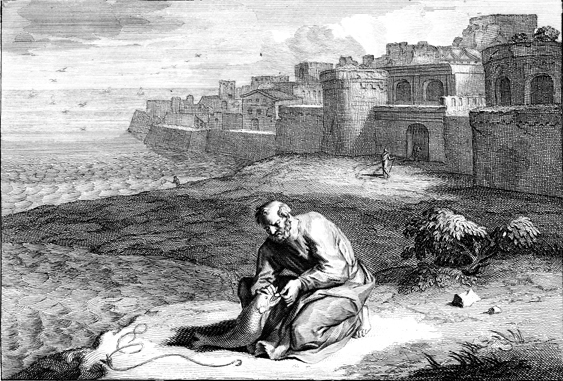
After Peter had been approached about paying the temple tax in Capernaum, Jesus speaks to him about the nature of taxation by kings. He makes the point that the sons of kings are exempt from paying such taxes inferring that he, as the Son of God (the king of the temple) is exempt from paying this tax. By extension, the followers of Jesus (adopted sons of the King) are also exempt from the tax. Nevertheless, Jesus states that this tax ought to be paid. Rather than taking the money from Judas’ money bag, Jesus tells Peter to go fishing. This fish miracle emphasizes that the provision for this “tax” is Jesus alone.
Taking the shekel[4] from the treasury held by Judas would have indicated a human solution to the human problem. Peter would not have understood it in the moment, but I think Jesus was drawing a parallel between this tax and the debt which is owed for our sins. Just as a coin from the mouth of the fish can only have come from Jesus, so it is for the payment for my sin required to satisfy God’s wrath – it can only come from Christ’s sacrifice on the cross. The coin in the mouth of the fish was freely given to Peter to pay his tax. As the apostle Paul wrote, “the wages of sin is death, but the free gift of God is eternal life in Christ Jesus our Lord.”[5]
This connection between fish and salvation helps explain the graffiti commonly used by early Christians. They used either a fish symbol or the acrostic “ΙΧΘΥΣ” (ichthys, which means “fish”) to indicate their presence or places of meeting. The acrostic which stands for “Ἰησοῦς Χριστός, Θεοῦ Υἱός, Σωτήρ” (Iēsous Christos, Theou Yios, Sōtēr), translates into English as “Jesus Christ, Son of God, Savior”. The use of this symbol became popular again among Christians back in the 1980’s, but its rich meaning is often forgotten. Hopefully, when you see this symbol now, you will be reminded of Christ’s free gift of salvation!

[1] Matthew 7:9-12 and Luke 11:10-13
[2] One of these sites was in Magadan or Magdala (the home of Mary Magdalene) whose name means “tower of fishes”. Jesus went to this place after feeding the four thousand in Matthew 16:29-39.
[3] Matthew 17:24-26
[4] The temple tax was an annual fee paid for the upkeep of the temple. The two drachmas would be equivalent to two day’s wages. One shekel was worth four drachmas – the amount needed for paying the tax for both Peter and Jesus.
[5] Romans 6:23
 Cicada Song
1 thought on “Miracle Fish (Part 2)”