The setting for nearly all the stories in the Bible is a semi-arid landscape dominated by rocky hills and valleys. Timber was in short supply, so stone was the building material of choice. At least in my imagination it seems to be a very lifeless stage upon which all the action took place. Is it possible that these rocks are participants in the drama rather than just bystanders? I confess I am heavily influenced by materialistic thinking and tend to look at rocks as inanimate objects, but there apparently is more to rocks than mere matter – at least Jesus (the Creator of the Universe) thought so.
At the beginning of the Passion week, when the Pharisees wanted Jesus to quiet his disciples as they entered Jerusalem, Jesus replied, “I tell you, if these were silent, the very stones would cry out” (Luke 19:40). I have no idea what that might have looked like, but it would seem that Jesus was not just waxing poetic here. There are other places in scripture where the Creation is recognized as having a voice.
King David described the heavens as being able to “proclaim his handiwork”, that the sky “pours out speech” and “reveals knowledge” (Psalm 19:1-3). David also wrote that all God has made will give thanks to him because “His mercy is over all he has made” (Psalm 145:9-10). The apostle Paul wrote that, until the end of all things, the whole creation (rocks included) is groaning in anticipation for the time when the world will be set free from decay (Romans 8:19-23).

To be clear, I am not trying to advance any pantheistic notions here – God is distinct from his Creation. Nor am I suggesting that rocks are living things with souls – the Hebrew nephesh in the Old Testament is only applied to humans and animals. But if God is both creator and sustainer of the universe[1], then to some degree, God exerts as much sustaining effort toward rocks as He does for you and me. If God is the maker of the universe, it is not beyond reason to think all things are capable of responding in some way to the One who is behind everything. So, there could be more to rocks than just molecules. It is very humbling, though, to think that rocks are just as capable of praising God as I am!
If rocks have some awareness of what God is doing in the world, it is interesting to think about what it may have been like for the rocks involved in those geologically prominent events recorded in the Old Testament: when the rocks split open and poured forth water for the thirsty sojourners, when Mt. Sinai rumbled as God came down to meet Moses, when the earth swallowed up rebellious Israelites in the wilderness, when the walls of Jericho came tumbling down, when the Philistines were destroyed after Samson knocked down the stone pillars, and when both King David and the prophet Elijah experienced earthquakes[2].

So, I wonder what those rocks on the road up to Jerusalem would have said if the disciples were silent. The followers of Jesus in that moment certainly did not have a clear idea of who Jesus was and what he was doing. They were excited about the possibility of a change – that they could be relieved of the Roman oppression. Their excitement was less about who Jesus was and more about what they could gain. If they really knew who Jesus was, they would not have turned about face a few days later and insisted that Jesus be crucified. Certainly, the rocks recognized their Maker, and could tell the world about him, but they had to defer to the people in that moment and had to remain silent.

Imagining that in some way rocks are capable of knowing what is going on around them, I wonder how they would have responded at the end of the Passion week. How did those stones on the path to Golgotha shudder as the blood of Jesus spattered upon them? What wails of grief and dismay did that hilltop have to suppress as the cross was sunk down into the ground? In what way were the rocks crying out at Jesus’ death when the earth quaked, the veil in the temple was torn and nearby tombs opened up.
After Jesus died on the cross, his broken body was laid into a tomb which was carved out of stone. Once all the people had left the scene, how would those rocks have cried out as they surrounded the lifeless body of their Creator, the Lord of the Universe? Would they have spent that Holy Saturday stunned with confusion? The One who could bring about the New Heaven and Earth lay lifeless before them. Or did they know all along? Did they have the faith of Abraham who willingly took Isaac to be sacrificed because he knew God could still fulfill his promise even if his son died[3]?
And what about that first Easter morning? What did those rocks experience when life was restored to Jesus’ body? What great surge of power must have entered that space to instantly heal all his wounds – turning back the process of decay which holds sway in the universe. Before the women came to the tomb, what great shouts of joy would have rung out from those rocks when the stone rolled away and Jesus stepped out of the grave? Would it not have been a great proclamation that “he has done it”[4]?
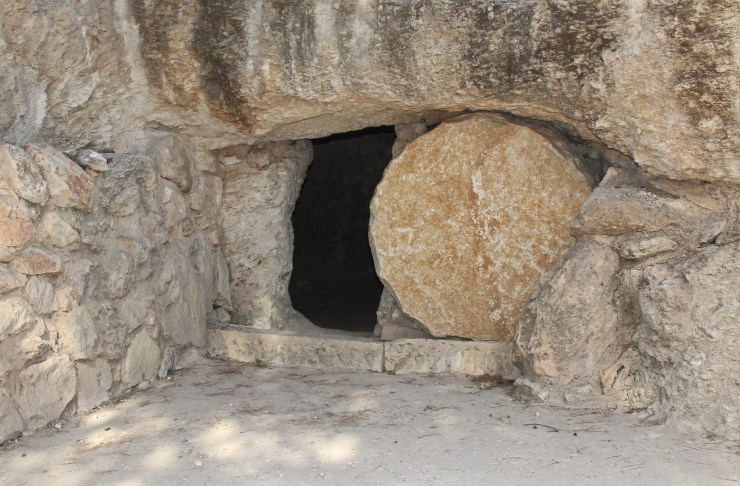
How frustrated must all those rocks have been as they held their voice in the presence of the bewildered disciples who peered into that empty grave? What exhilaration might the rock walls have experienced as Jesus passed through them to visit the forlorn disciples who were hiding out in that upper room? What would the stones have wanted to call out as Jesus walked alongside the clueless disciples on that rocky road to Emmaus?
Later, Jesus met his disciples for breakfast on the shores of Galilee. Would the sands on that beach have breathed a sigh of relief as the disciples experienced God’s great forgiveness and finally came to realize the significance of Jesus’ death and resurrection? Would they have held their breath in anticipation of what was yet to come as Jesus directed the disciples to carry out the mission of spreading the good news?
And what about now? Are the rocks still waiting in silence? Are we effectively taking the place of stones? The apostles Paul and Peter both conveyed how Christians are living “stones” being built into a spiritual house – being built into the temple of God[5]. Are you one of those stones? Hopefully, God will not need to use rocks because we are doing what we should be doing!
[1] See John 1:1-3, Colossians 1:16-17 and Hebrews 1:3
[2] Ex 17:1-7; 19:18; Num 16:31-33; Josh 6:20; Judges 16:25-30; 2 Sam 22:7-8; 1 Ki 19:11
[3] Hebrews 11:17-19
[4] Psalm 22:30-31
[5] 1 Pet 2:5; 1 Cor 3:10-16; Eph 2:19-22
 Cicada Song