The structure and function of the human eye have long been in the cross hairs between those who suggest what we see in nature is best explained by natural processes and those who think an intelligent creator is a better explanation. The eye is something that gave Darwin some pause regarding his own theory when we wrote, “ To suppose that the eye with all its inimitable contrivances…could have been formed by natural selection , seems, I freely confess, absurd in the highest possible degree”.[1] Darwin could not point to any evidence of transitional forms which led to the formation of the eye, and recognized that, “we should probably have to descend far beneath the lowest known fossiliferous stratum to discover the earlier stages, by which the eye has been perfected”.[2] He convinces himself of his argument by deferring to his imagination (what he oddly refers to as “reason”) as evidence for the development of the eye.
Since Darwin’s time, the search within the fossil record has yielded no more evidence than Darwin had regarding the eye. Further, our understanding of the structure and function of the eye has only advanced, making it even more difficult to imagine an evolutionary progression which could produce the eye. Lacking compelling evidence for a naturalistic explanation, evolutionary biologists have taken an interesting tack by asserting that the vertebrate eye is of poor design. Since a poor design would not have been the product of an intelligent creator, the only possible explanation would be evolutionary processes.
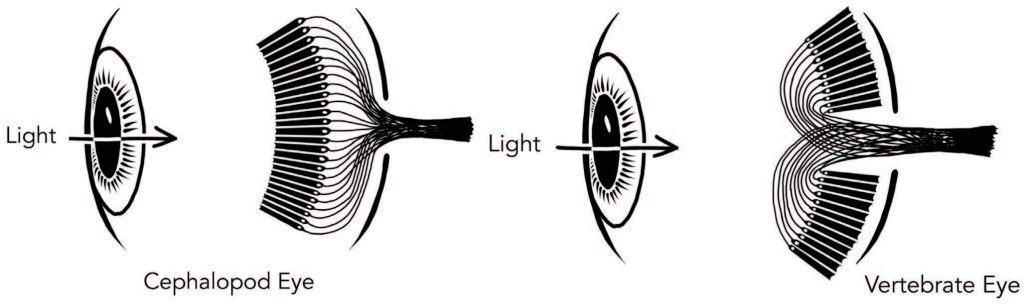
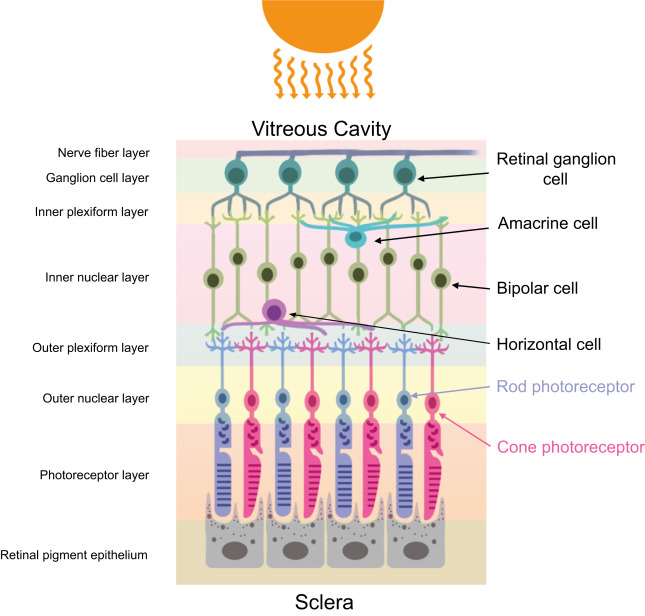
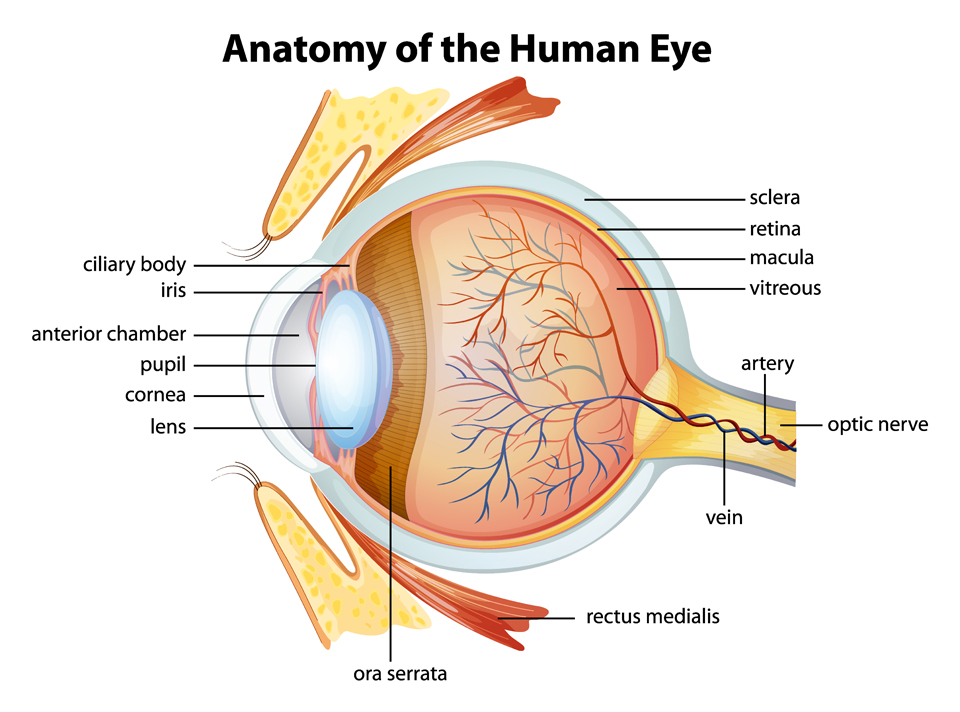
In an article by Jonathan Wells, “Is the Human Eye Really Evidence Against Intelligent Design” (link) he first provides a number of quotes from prominent evolutionary biologists including Richard Dawkins, Kenneth Miller, Douglas Futuyma and Jerry Coyne who echo this idea of poor design. They all point to the “backward arrangement” of the light sensitive retinal cell which are positioned away from the light source rather than toward it as is observed in the cephalopod eye (squids and octopi). This arrangement results in the neurons from each retina cells gathering in one spot to form the optic nerve which then results in a “blind spot” in the retina. This, these biologists parrot, would never have been designed by any intelligent human engineer.
Wells goes on to point out that this arrangement of retina cells is actually an optimal design which does not impair our ability to see. This positioning of retina cells as found in the vertebrate eye enables them to be situated close to a blood supply – essential for nutrients and oxygen. It also places them adjacent to an epithelial cell layer behind the retina which serves two additional functions. This pigmented cell layer absorbs scattered light which improves visual resolution. These cells also are important in the essential processing of chemicals produced by the retina cells. The so called “blind spot” really is a moot point as it results in no real impairment of vision. So, rather than being of poor design, it appears the eye has a very good design. What is embarrassing in all this is that we were aware of these optimal design features long before these evolutionary biologists made this assertion.
While it seems Wells scored a point over these other biologists, it should be noted that this manner of argumentation is fundamentally flawed, and not very productive. Even if these fellows ultimately concede that the positioning of the retinal cells is a good design after all, that will not necessarily move them into a position of recognizing there is an intelligent designer. They could easily find something else about the eye which is not to their liking and reassert their poor-design claim. Another tack would be to simply invoke the oft-repeated phrase, “evolution will find a way to make things work” – what ever exists, good or bad, could come about by evolution. Realize that this is an assertion without an explanation.
Whether something is of poor design or good design is rather ambiguous. To suggest that X would be much better if it had Y is an unverifiable claim when it comes to biological systems like the eye. I might imagine how one part of the eye could be better, but I am not able to put such a thing in place to see if it really works better. In systems engineering in which there are multiple moving parts, it is about optimization not maximization – there must be trade-offs to accomplish a particular purpose. Improving one aspect of a system may result in the degrading or diminishing of another aspect.
The poor design (dysteleological) argument is also pretentious. It masquerades as a scientific argument when it is nothing more than an unsubstantiated theological claim. It takes the form of, “an intelligent designer would never have done X this way”. The argument really is not about X, it is about the designer. In order to make such a claim, they need to have the ability to know what God would or would not do in order to accomplish His purposes. If a design accomplishes the purposes of its designer, then that design would be considered “good”. Anyone’s opinion about the matter is superfluous.
Materialists will often accuse theists of arguing from incredulity – that something is so amazingly complex it could only have been done by God – often referred to as a “god of the gaps” argument. Here the theist may not be entirely wrong – complexity still must be explained, and what if naturalistic explanations fail? Where the theist may be accused of arguing from incredulity, the materialist can be accused of arguing from audacity. They fail to appreciate how well things work given the necessary design constraints. They fail to provide an explanation for how the assemblage of multiple interdependent parts could come about.
Whether something exhibits intelligent design or not is not determined because it meets my preferential standards. My car breaks down and wears out which is not much to my liking, but that does not mean my car was not a product of intelligent agency. Darwin described the limits of random variation to produce change or improvements in biological systems. He wrote, “If it could be demonstrated that any complex organ existed, which could not possibly have been formed by numerous, successive, slight modification, my theory would absolutely break down.”[3] Each successive modifications must pass the test of natural selection – they would have to confer an advantage to the organism. If some new feature comes into existence but is dependent on the simultaneous appearance of other features, it could not confer an advantage and would not be preserved. We see this dynamic many times over with the structure and function of the eye.
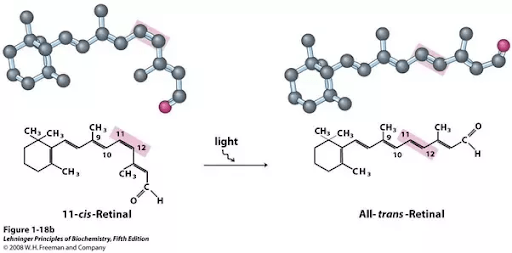
At the heart of the eye’s ability to function is the presence of a membrane bound protein called rhodopsin which is found in the retina cells. Rhodopsin is an opsin protein with a little pocket that holds a molecule of a vitamin A derived chemical called 11-cis-retinal (RC). When exposed to photons, RC alters its shape to become all-trans-retinal (RT). This in turn alters the shape of rhodopsin. Keep in mind that location matters. Rhodopsin must be situated in a particular place in the cell membrane and would have no function if it was just freely floating around inside the cell.
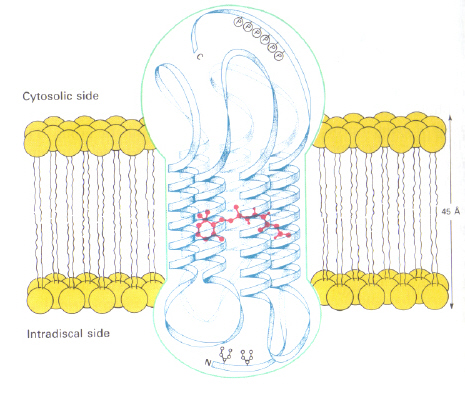
The conformational change of rhodopsin is the beginning of a multi-step transduction pathway – the process which generates a nerves signal which goes to the brain. Each step in the transduction pathway involves a specialized membrane bound protein. The happy accident of producing RC would not confer an advantage to an organism unless the opsin protein and this transduction pathway were already in place. Conversely, opsin and the transduction pathway would not be of any help without the existence of RC. But it does not stop there.
Once the light sensitive molecule has been altered by exposure to photons, there is another multi-step process to return RT to its former state. The RT must leave the light sensitive cell and be taken to an adjacent cell layer in which several specialized proteins are involved in converting this protein back into RC. Then, RC can be returned to the light sensitive cell to do the process all over again. As before, the RC would not confer an advantage to an organism if the restoration pathway was not in existence, but the restoration pathway would not confer an advantage unless the photon-altered molecule existed.
On a larger scale, these photoreceptive cells would be of no use unless they could be struck by light. So, we find in the eye two transparent structures – the cornea and the lens. These tissues are transparent because they have been cleared of capillaries. This is problematic because the living cells in the cornea and lens still need access to nutrients and oxygen. To remedy this, the eye contains pockets of fluid (the aqueous humor and the vitreous humor) which supply the cornea and lens with what they need to live.
The clearing of capillaries in these tissues would confer no advantage unless nutritive fluids were already in place but these fluids would not need to be present unless there were no capillaries in the lens and cornea. Not only do these fluids need to be produced, but the pressure they create within the eye needs to be regulated (glaucoma patients know all about this). For good reason, transparent tissues are exceedingly rare – they are only found in the eye. These transparent tissues and their supportive fluid systems would not confer an advantage unless the photoreceptive cells were functional, but they are required in order to make the photoreceptive cells functional.
Without going into detail, I would be remiss if I did not recognize the importance of the cornea and lens in focusing light images onto the retina. These tissues both require a high degree of structural design in order for the light images to be clear and discernable. Additionally, the eye possesses an iris which enables an organism to see in various degrees of lighting and also protect the retina from damage by high intensity light. The iris has its own set of interdependent complexities which allow it to function.
When the eye is fully functional, the photosensitive cells can transmit nerve impulses at a rate of up to 400 per second (depending on light intensity). Movies on film will feed new images to us at a rate of 23 pictures per second. The retina is delivering image data 17 times faster! Impressively, the retina in the human eye contains 123-130 million photosensitive cells. This tremendous transmission volume would be of no use to us if the brain could not interpret all that data. These nerve impulses – these shocks in the dark – need to be converted into what we perceive as a visual image. Just to produce these nerve impulses, there is a long chain of interdependent mechanisms essential to our ultimate ability to see the world around us.
In his thoughts about the eye, Darwin attempted to draw an interesting analogy: “It is scarcely possible to avoid comparing the eye to a telescope. We know that this instrument has been perfected by the long-continued efforts of the highest human intellects; and we naturally infer that the eye has been formed by a somewhat analogous process”. He was reticent to accept this idea when he wrote, “But may not this inference be presumptuous? Have we any right to assume that the Creator works by intellectual powers like those of man?”[4]
I agree that we must be cautious when we try to determine what the Creator would do or not do. However, because God has created mankind in his image – that we have been endowed with a capacity for knowledge, a sense of purpose and order, and the ability to reason – the inference is apt, though imperfect. We are designers, and we can detect when objects are the product of design rather than being a result of natural processes. We do not need to presume that the Creator’s “intellectual powers” are like ours – we should presume better – that the creator has much better foresight in order to know how to optimize all the different features in a system.
When it comes to the systems engineering evident in the structure and function of the eye – that there are multiple interdependent structures and processes in place – we need to think about which best explains this. Systems engineering requires tremendous insight, foresight and intentionality which would not characterize the processes of random gene mutations and natural selection. By our human experience the interdependencies found in the eye are significantly more likely to have happened by intelligent agency than random mutations.
[1] Charles Darwin, On the Origin of Species [A Facsimile of the First Edition] Harvard University, Cambridge, MA, 2003 (8th printing), 186.
[2] Ibid, 187.
[3] Ibid, 189.
[4] Ibid, 188.
 Cicada Song