One of the curiosities found in the Old Testament is a creature referred to as the Behemoth in the book of Job (40:15-24). It is a curiosity because this word is used only once in all the Old Testament. The term “behemoth” is a plural form of the Hebrew word used to refer to animals in general. Plural forms can be used as a superlative indicating something being great or large as opposed to being numerous. It is not the name of the creature, so the creature being referred to must be deduced from the description which follows. Most scholars believe “behemoth” refers to a hippopotamus for several reasons.
The first clue is that we are told this animal eats grass like the ox (v. 15). Hippos will leave the water at night to forage along the banks of rivers and lakes for 5-6 hours. They will eat mostly short grasses consuming about 80-100 pounds of food per day. Unlike an ox, hippos are not ruminants, but they do have a multi-chambered stomach in which fermentation of carbohydrates does occur – a way to improve the nutrient absorption from a food which is difficult to digest.
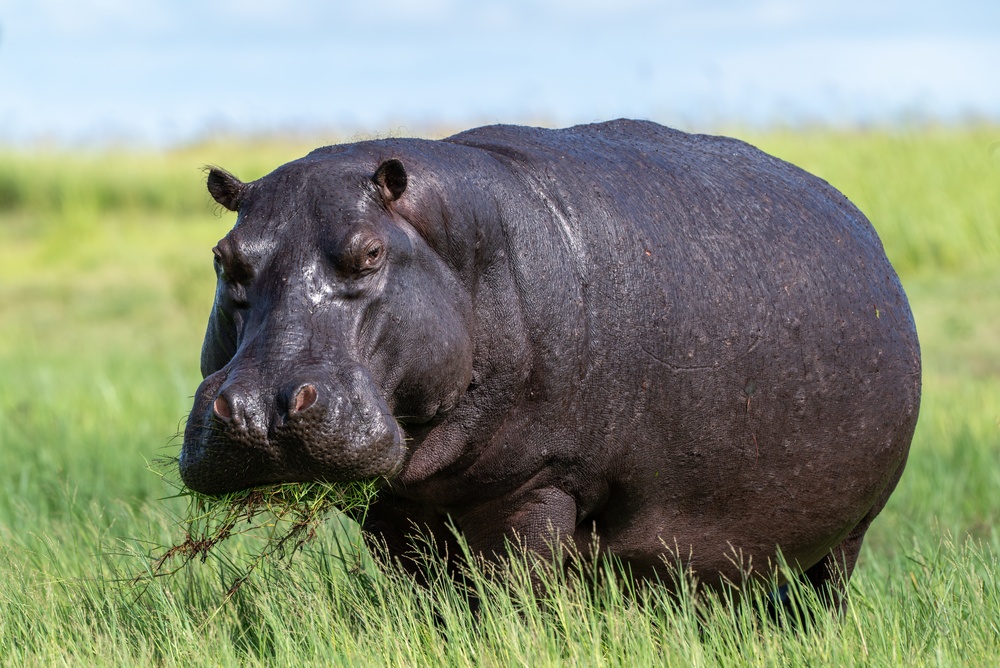
In its description, God also highlights the great strength of this animal’s muscles, both in its legs (loins) and belly (v. 16). Because of their large size and seemingly short legs, many assume the hippo is a slow-moving animal. On the contrary, for short distances, hippos can run at speeds up to 30 km/hr (19mph). This is quite fast compared to the average human who may run at about 13 km/hr (8 mph). It has been noticed that when hippos are galloping there are times when all four of their feet leave the ground – hippos can “fly”![1]
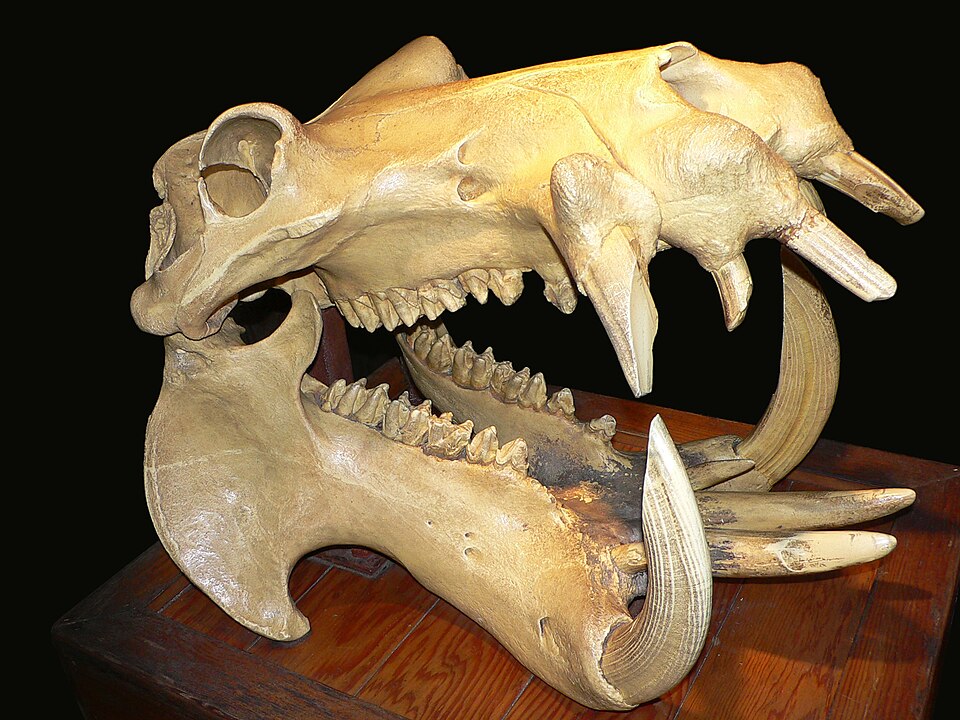
Specific mention is made in the text of the hippo’s bones (v. 18) which are likened to bronze and iron – no surprise for an animal which can weigh up to five tons. Males are considerably larger than the females averaging between 1,000 and 3,200 kg (2,200 – 7,100 lbs) while females check in between 650 and 2,300 kg (1,400-5,100 lbs).[2] A hefty set of bones is essential to support that much mass and withstand the great force put upon them by their muscles.
https://en.wikipedia.org/wiki/File:Hippo_skull_dark.jpg
Another remarkable thing about the hippo alluded to in the text is its mouth (v. 23) – that the hippo is not overwhelmed even if the river Jordan runs into its mouth. The hippo is capable of opening its jaws to a 150-degree angle and its mouth is equipped with very sizeable canines. Not only can it open its mouth wide, but it can close it with a tremendous bite force. This feature is of no use when it comes to eating grass but instead is important for fighting and defending its territory.
The identity of the behemoth is also implied by the description of its habitat. It tells us this creature is concealed by lotuses (aquatic plants with floating leaves and flowers) and willows that grow at the edge of the river (v. 23). While hippos come out of the water at night to feed, they stay cool during the day by staying submerged under water.
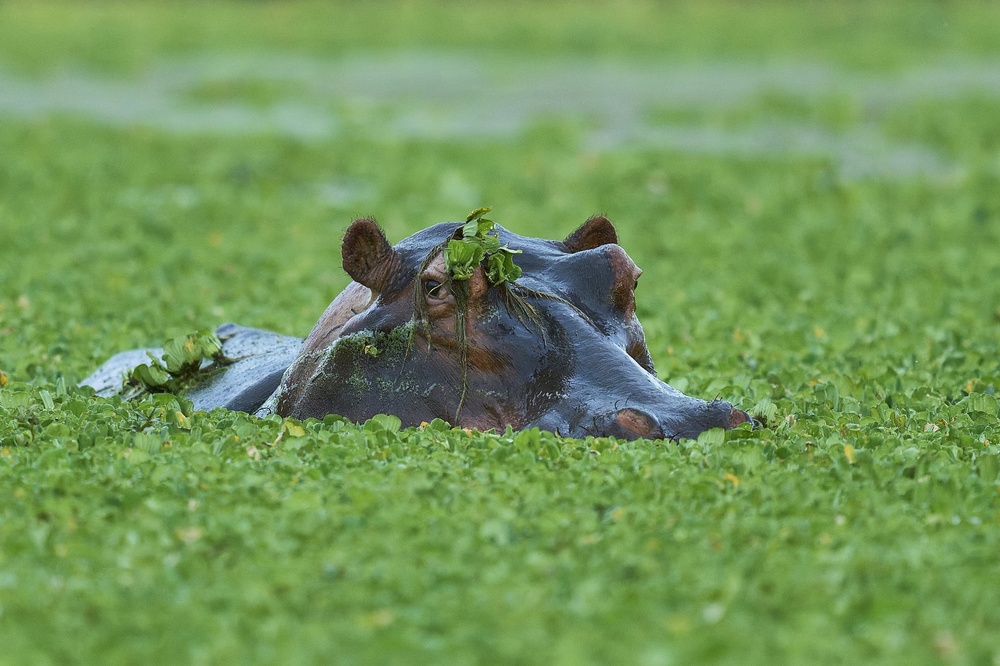
God also seems to point to the disagreeable nature of this creature which aligns with hippos. If a hippo is provoked (and sometimes when it is not), it will charge. Hippos have also been known to overturn boats in the river. There are an estimated 500 human deaths each year[3] either by being trampled or drowned. With its tremendous mass, considerable speed and formidable jaws, this is not an animal to be trifled with. Indeed, “can anyone capture him by the eyes, or trap him and pierce his nose?”(v. 24) – they cannot be tamed.
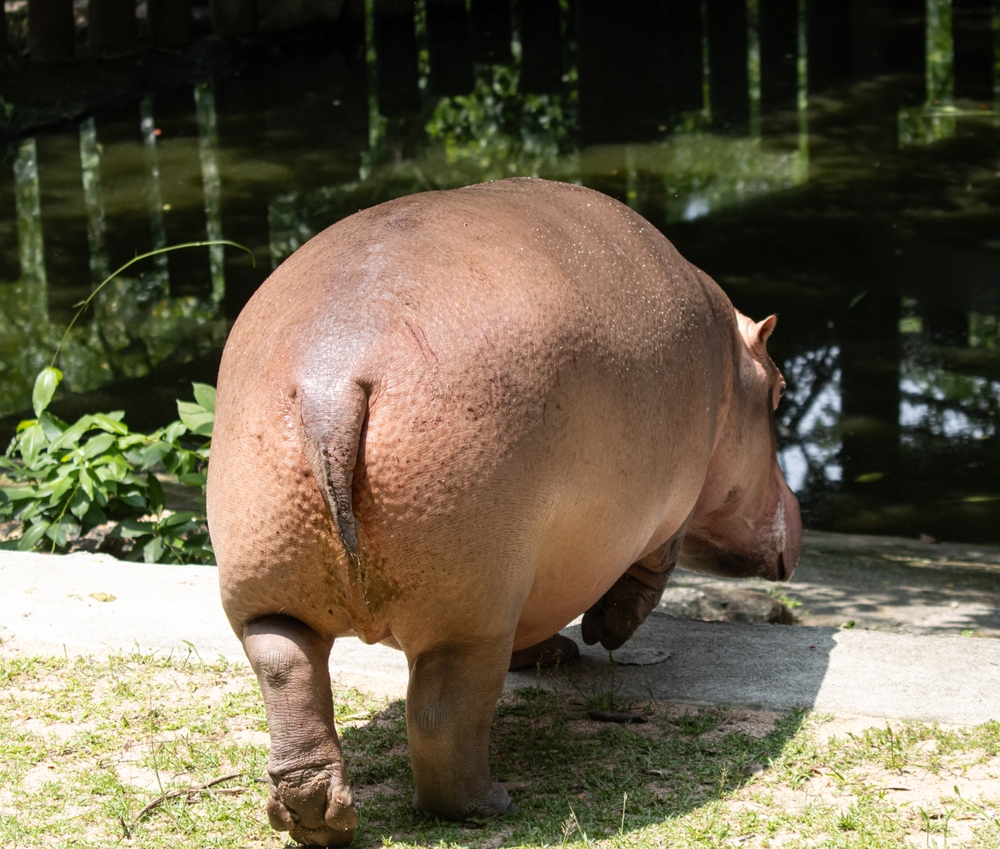
The one sticking point which prevents some people from affirming that the behemoth is a hippopotamus is the description of its tail. The Hebrew text simply says that its tail is like a cedar (v. 17). English translations will try to elaborate on this by adding some quality of cedars – that it sways or moves like a cedar or that it makes its tail stiff like a cedar. These don’t seem to align well with the short stubby tail of a hippo, and don’t seem to add anything to what is otherwise a description of a veritable monster.
I think the problem lies in the interpretation of the metaphor. Some have assumed that likening the tail to a cedar means the behemoth’s tail is of great size. This could be a possibility when we think, for instance, of the large cedars which were brought in to build the palace and temple in Jerusalem. Those who take this approach also suggest that the behemoth was a dinosaur like a sauropod which had a very long tail. For those who assert this, there seems to be a bit of begging the question going on (i.e., assuming what you are trying to prove). This inference does not seem very tenable since there is nothing else in the Old Testament which indicates the presence of dinosaurs in Palestine.
The challenge with metaphors is in correctly connecting the quality of the referent (in this case, the cedar) to the subject (the tail of the behemoth). Yes, cedars are large, but is that their only quality? A couple passages in Ezekiel refer to the long spreading branches of cedar trees. Ezekiel 17:22-24 describes the coming messianic kingdom to be like the abundant provision of the spreading branches of a cedar tree. Ezekiel 31:3-9 compares the spreading branches of the cedar tree to the spreading of the Assyrian nation. So, what does the quality of spreading have to do with the tail of a hippo? Bear with me here.
One of the disagreeable things about hippos is what they do with their tails when they defecate. Hippos will rapidly move their tails back and forth while they defecate causing their feces to spread in all directions. It has been suggested this behavior is useful for marking their territory. It may also be useful as a defense maneuver. Could this be the way in which the behemoth’s tale is like a cedar – that it is spreads its manure like the cedar spreads its branches? Maybe. It certainly is one more way in which a hippo is unapproachable and difficult to capture or be tamed.
More important than figuring out how the hippo’s tail is like a cedar is understanding why a hippo is in this passage in the first place. The context for this description of a hippo is God’s rebuke of Job and his friends in their attempt to explain Job’s suffering. Just as the cedar is a metaphor for the hippo’s tail, the hippo itself is a metaphor for suffering. Just as God made the hippo, he also made suffering – at least he made a world in which suffering can exist. The passage describes the hippo (suffering) as something which “ranks first among the works (ways) of God” (v. 19). It is an ever-present feature in the life of every human being. It is the thing for which every world view seeks to explain.
Just as the hippo withstands the rising of the river with the spring runoff (v. 23), suffering will persist through the tides of time. The spring runoff coming down from the mountains helps provide food for the hippo as it waters the grass upon which it feeds (v. 20). Similarly, time continually brings along situations which allow suffering to flourish as well. This passage gives us ample description of a hippo, we can likewise provide lengthy descriptions of all the suffering in the world, but that does not mean we can get a handle on it. When we, like Job and his friends, try to explain the suffering present in a person’s life (taming the hippo), we may end up with manure on our faces or something worse. While suffering may bring consternation to our lives, this passage also gives us a word of hope.

While we as humans are incapable of gaining control over suffering, this passage tells us that the God who allowed suffering to be present in this world is the very same God who can kill it. It says that “his Maker can approach him (the hippo) with his sword” (v. 19). This is the great hope that we have in Christ. The prophet Isaiah tells us that God will “swallow up on this mountain the covering that is cast over all peoples, the veil that is spread over all nations. He will swallow up death forever”. (Isaiah 25:7-8) The apostle John writes that in the end God will “wipe away every tear from their eyes, and death shall be no more, neither shall there be mourning, nor crying, nor pain anymore, for the former things have passed away.” (Revelation 21:4)
So, yes, suffering is a beast. A very large beast. It is not easy to deal with. Humans will forever try to explain why suffering is in our lives. At least we understand there is some purpose behind it, but what that purpose exactly is in every situation will escape our grasp. As long as we must endure it, our comfort comes from the one who wields the sword – the one who promises to be with us in the midst of our suffering. We can be like David who wrote, “Even though I walk through the valley of the shadow of death, I will fear no evil, for you are with me”. (Psalm 23:4)
If you are wondering how God can use suffering for good, one of my professors at Biola University, Clay Jones, and his wife, Jean, just came out with a book on this very topic: How Does God Use Suffering for Our Good?
[1] https://www.forbes.com/sites/grrlscientist/2024/07/05/when-hippos-fly-hippopotamuses-can-run-so-fast-they-become-airborne/, accessed 07/22/26
[2] https://tsavotrust.org/how-much-does-a-hippo-weigh-and-other-hippo-facts/, accessed 07/22/26
[3] https://www.discoverwildlife.com/animal-facts/deadliest-animals-to-humans, accessed 07/22/26
 Cicada Song
